Thursday, 22 January 2015

A Guide to Buying an Electric Guitar

Les Paul
The two main legendary pioneers in electric guitar history are Leo Fender and Les Paul. They invented what we know as the modern electric guitar and since then, (50+ years ago) nothing has really changed. In fact, modern players pay huge dollars for early (vintage 1950's/1960's) models and companies like Fender and Gibson constantly reissues their older model trying to capture that magical tone of the old guitars. My main guitar is a reissue of a 1962 Fender Stratocaster and I have found in the guitar world that technology has had a hard time improving on that old recipe that never fails to deliver great tone and character in almost every musical context I would use it in. Your choice will be indirectly influenced by a history we sometimes take for granted and a age old design that has seemed to reach it pinnacle of design.


I wanted something very dense, something that would sustain long and more pieces of wood that would be soft, sweet, for more of a mellow sound. Quote - Les Paul


Leo Fender
When shopping for an electric guitar you will basically be choosing between a Fender Stratocaster or a Gibson Les Paul style guitar. There are other variations but virtually 90% of all guitars will fit loosely into these two categories. Fender style guitars generally have a thinner, open and cutting tone that is perfectly represented in players like Eric Clapton, Jimmy Hendrix, Jeff Beck, John Mayer and Mark Knopfler. Gibson style guitars have a thicker, darker and muscular tone and are championed by players like Jimmy Page, Peter Frmpton, Slash, Angus Young and Joe Bonamassa. My starting point for choosing an electric guitar has always been to follow in the footsteps of my favourite players.

The design of each element should be thought out in order to be easy to make and easy to repair. Quote - Leo Fender

When making your choice, choose a guitar that goes with your style preference and the type of tone you might need to play that style. Most country players use strats or telecasters for a thinner, twangy tone that cuts through the mix. Metal players go more for Les Paul style guitars with big, bold and crunchy tone. Blues player have generally chosen Strats over Les Pauls and Rock and Pop players make sure they have a mix of guitars for different musical whims and situations. To confuse the process, there are fatter sounding strats style guitars and thinner sounding Les Paul style guitars that  add complexity to your choice but can ultimately help you find that perfect mix of sound and feel. For example, my Fender Hotrod '62 is called by some, the Les Paul of Stratocasters. It has a vintage Strat sound with some added fatness of a Les Paul style guitar. I have always loved the sound of a Strat but the style I play needs a fatter tone so I have found a good mix in this guitar.

Practical Choices:

For your first guitar, I would suggest the conservative approach of buying a well-known established brand and a fairly basic 'tried and true' body style. Most of the legendary guitar Icons of our day play very basic styles of guitars and have learned that most of the magical tone comes from their highly trained and experienced fingers.


Saturday, 10 January 2015

TAB vs. Standard Notation

Guitar TAB (short for tablature) is the most popular way of reading music notation for modern guitarist. Hundreds of website on the internet offer thousands of songs in this 'easy to use' notation format and the majority of published songbooks now prefer TAB because of it's universal appeal, practicality, and efficiency of use to the modern recreational and professional guitar player.

This modern TAB trend has had it's fair share of critics and dissenters mostly among music teachers and professional players for it's apparent "dumbing down" of the process or art of studying music in the proper traditional way with the result of creating a world of illiterate musicians. Hence the proverbial joke being, "how do you shut up a guitar player? - put a piece of music in front of him/her.


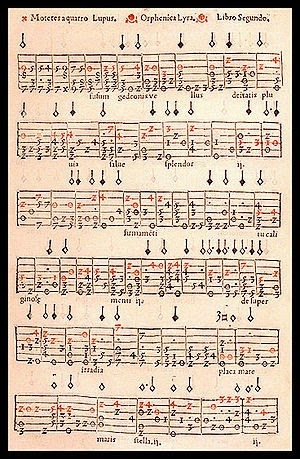
Lute TAB from 1554
When confronted with this attitude,  I truly sympathize, understand, and clearly see the results of a general musical illiteracy and the decline of most modern music to the lowest basest form of mind numbing stimuli and soundbites for the purposes of entertainment only. The problem is, that if we look at TAB in the historical context (dating back to the 15th century) it has been around longer than the invention of the guitar and deserves to be critiqued within a broader picture and context. The descent of music is a mirror of the decline other things in our modern culture and must be viewed in the context of art and technology and the participation and use of music in our local economies and communities.

The Big Picture

As a professional guitar teacher I use TAB notation for 95% of my students studying for recreational purposes and 50% of the time for university and college music majors. Using TAB allows me to get my students playing and doing music more and reading and thinking music less. To me, that's a great starting point that creates momentum, confidence, and openness in the journey and process of the enjoyment and making of music. Once that 'playing field' is open there are many opportunities to fill in some of the missing gaps during the 'game'. 


Final Thoughts

Unless you are studying music for the purpose of becoming a music educator, studying traditional forms of music like classical or jazz, or as a professional guitarist, standard notation can be bypassed in favour of TAB as a more efficient, enjoyable way of learning the techniques of guitar. You'll fly through the music 5 times faster and once your on your way, standard notation might be something of value later in your journey.

Have fun on UltimateGuitar.com

Monday, 29 December 2014

A Guide to Buying an Acoustic Guitar

Buying an acoustic guitar can be an intimidating, foreign and perplexing event for many people: mostly because it's a unique and rare purchase of a relatively unknown, specialized item that will be used in a highly personalized pursuit of technique and art. More simply put; it's beneficial to have some help from someone with experience when buying a new or used guitar.

I will, as very experienced guitar buyer assist in this adventure with 3 different price points: under $400, under $1,000, and over $1,000. We can also label think of these 3 as: beginner/starter guitar, intermediate/semi-pro guitar, and a professional/lifetime/investment guitar.

Buying a guitar under $400

Seagull S6
The main thing to look for in the starter guitar category is choosing a product from a widely know established manufacturer and company with a good warranty and a proven track-record for quality guitars at a reasonable price. Companies I would recommend in the beginner category are Yamaha, Fender, Seagull, Simon & Patrick, Cort, and Art & Lutherie.

Choose a guitar that looks good, feels comfortable and sounds warm and inviting to play. Ask a salesman to play one or more for you so you can judge the differences for yourself. At this level of quality, your main interest is in a serviceable, playable, and affordable guitar that will get you playing and learning without 'breaking the bank'. Most beginner guitars are manufactured from a plywood type of laminate would and will have a limited tone quality. Simon & Patrick, Seagull, and Art & Lutherie are exceptions to this and get my vote every time as the 'best for the least $$$'.

Buying a guitar under $1,000
Taylor 100 series

My wish as a guitar teacher would be that most students skip to this level from from the start. Learning and playing on a good instrument inspires and responds to the growth of player with each hill of technique and repertoire they climb.

Acoustics in this price range generally have solid wood tops and synthetic ivory bridge saddles and nuts which brings the quality of overall tone way up. The use of tone friendly woods in the construction usually adds to the warmth, clarity, and overall character of the sound. In this category, don't be fooled by the fancy paint jobs, flashy electronic pickups, and intricate inlays and binding that can make a lousy guitar tempting to purchase. Companies like Takamine, Dean, and Fender can be guilty of selling many '3's dressed up as a 9' in this price range.

Companies I would recommend for guitars between $400 and & $1,000 are Taylor, Seagull, Simon & Patrick, Godin, Yamaha, Larivee, and Martin. These companies, in my opinion, build with a traditional tone-first strategy, putting more resources into the tone rather than the bells and whistles.

Buying a guitar over $1,000 


Goodall Concert
Jumbo

Buying a guitar that is over a $1,000 should be seen as an investment;  not only in a item that will hold it's value, but in an instrument that will grow with you as time passes, that will inspire each time your fingers touch the strings, and will invite the guitarist to play just by looking at it. For example: my Goodall Concert Jumbo is very beautiful and inviting to look at, ultra-sensitive to every move of my fingers, generates fantastic tone from every atom and molecule it's made from, and it took me 4 years to save up enough to buy it. In my work as a professional guitarist and teacher I have a good excuse to spend on a quality, hand-built instrument but I would rather save and wait for quality over quantity in every area of my life. 


If you find joy in playing the guitar and see it as a part of your future, my challenge to you would be to invest some time in investigating and researching your options and all the benefits of purchasing an instrument of lasting quality and one that's built for performance and ease of playing while your learning and growing as a player.

I sometimes use this example: we will have no problem in dropping $1,000 - $1,500 on a computer that will be obsolete in 3 to 5 years but will choke at the prospect of spending the same on a guitar that will last a lifetime. Find a good fit for you from the 3 categories and choose wisely.


Monday, 15 December 2014

Keeping in TIME ( a gude to better strumming ) - Part 1


Rhythm is the most important part of music. It keeps the moves the music along , glues the musicians together, and touches the listening down in their souls. Guitarist are 1/3 of what'a called the 'Rhythm Section' in a band. Along with the drummer and bass player they play the role that is the foundation of contemporary western music.


Here's how it works  (generally)

The drummer is the chief 'time-keeper"and sets the tempo for the music. The bassist accents what's called the 'downbeat' (beat 1 along with beat 3 of a 4/4 bar) and the guitarist accents the back-beat (beat 2 and 4 of the 4/4 bar). All together this sets the 'groove' or 'pocket' of the rhythmic pulse of popular music, and a good 'rhythm section' will be tight and consistent in this effort.

The beginning rhythm guitarist

I will generally teach about 4 - 6 simple strum pattern to all my student. These patterns usually cover all the basic guitar rhythms for folk, country, pop, rock and funk styles and get the student playing faithfully along to the actual recorded versions of the songs. Once the student gains confidence and consistency with these patterns, I will encourage their creation of new patterns based on adding or subtracting strums to these basic existing patterns. The result is trying to get the most out of the least, and encouraging the creative talents of the individual student rather than the memorization of countless patterns. An example would be; remove one strum from the basic folk pattern and it turns into the "Mumford and Sons" pattern used by all the modern alternative folk-rock bands these days.

The 'Quest' continues ...

The next step in the process is to begin to become proficient in choosing what the best strum pattern for a given song will be. Most songs you print off the internet or get from anthologies won't have a strum pattern included with the chords and if your guitar teacher isn't there to write one in, the task is yours to decide. Also, if your playing in a band you will have to choose what will work and sound best with what the other players are doing on their instruments.

The process isn't unlike adding salt or pepper to season your food. You'll have to step out and try what you think will be the appropriate pattern and learn from a bit of trial and error. Most of the time there isn't really a right or wrong rhythm anyway because there are so many ways to approach a song in the area of rhythm. Foe example, I could play a funk song in a straight ahead rhythm or a rock song in a funky way or pop song in a folky way. There is a lot of variety and cross pollination within modern music so it's not difficult.

So until 'part 2' (coming soon!) work on customizing those few patterns you're comfortable with and experiment with trying to play along with mp3s and recordings of the atrists and bands.


Thursday, 11 December 2014

iRig - Plugging your guitar into a iphone or ipad


The AmpliTude iRig is a mobile guitar amp with effects for your iphone or ipad. You can plug your guitar directly in and monitor the sound with headphones, powered speakers, or through a P.A. system. You'll have dozens of different amps to choose from and a crazy amount of guitar effect to add to the mix. For some guitarist this means being able to travel lightly and conveniently without the worries of wear and tear on your traditional guitar rig. For the beginner player this is an affordable and easy way to have great tone literally at your fingertips without having to navigate through the myriad of expensive guitar amp and effects. Check iRig out. It ultimately might not replace the real thing, but the sounds are good enough and used by many pro players.

Monday, 8 December 2014

The "ART" of Practice ( part 2 )

In the Art of Practice (Part 1) I mentioned that there was no art to the 'getting to' or the 'doing' of practice. It's just the plain fact that the only sure-fire way of consistent practice for most people is scheduled practice: just like sports or theatre.

I think I can give some advice on the Art of Practice once a regular and consistent practice of the guitar is taking place.

Slow down

We can take our cue on this part of the art of practice from the legendary Canadian pianist Glen Gould. He would often practice new songs at half-speed so he would never make a mistake or error in his playing of a song. He thought (and I think he's right) that mistake our 'videotaped' in our minds only to resurface or replay later in time. So, slow down and practice perfectly and don't get in the habit of practising a mistake. It will only return and replay during performance.

Relax

Learn to work and practice with a healthy amount of patience a let the the success in what you do be just a by-product of doing the work with enough repetition to perfect it. Just like the famous quote, "eat the elephant one bite at a time".

Stradegize

Have a plan on what you want to accomplish during practice. An example of this would be: I want to get a certain number of bars of music down; I want memorize a certain lick or passage of music; I want to understand the harmony behind the chords; or I want to get to know the scales or patterns needed to improvise in this son. So you will practice until that element or part of the work is done.

Conquer (gaining confidence)

Personally, I build my confidence in my abilities by conquering the task at hand. The secret is really simple; "in competing the task I learn to do the task." We just get caught up in too many of the particulars that we're setting ourselves up for defeat.

Play

A big part of practising is having enough play time to keep the joy and remind ourselves of the reason we started playing guitar in the first place. Have unscheduled, spontaneous, and unstructured times of making noise or jamming on your guitar where you just let go and let the fingers fly. I sometimes turn all the lights off in my studio and just jam to mp3 without a care in the world.


Pedalboards and Pedals - part 2

In continuing the theme of pedals and effects, I want to share some thoughts regarding choosing the right gear for your musical context and style with your overall budget in mind. I keep my pedal setup to a very small amount of carefully chosen pieces that work for the context and style of music that I general play. Here are some thoughts:

Think of each gear purchase as an Investment

Don't get caught up in the trap of filling up your room with a bunch of cheap guitars, hooked up to cheap gadgets, wired together with cheap cables, through a cheap amp that ends up sounding like a chain-smoking cat weezing on a furball. Save your pennies, be patient, and buy gear that will last and grow with your playing.

Quality over Quantity

Find out what kind of pedals and accessories your favourite guitarists and artists use and try to start with a few of those choice pieces. Remember they can probably afford the best gear so you can't go wrong in emulating their choices.

Style and Context

I tend to keep all my pedals loose and sitting on the floor and I generally take whatever pedals I need for the gig. If it's a jazz style gig I might take my Strymon reverb and an amp. If it's a rock show I'll bring all my overdrives like my vintage Ibanez Tube Screamer, Carl Martin Plexitone, Rockbox Boiling Point and my Xotic EP boost for solos. If it's a church event I make sure I take my Strymon Blue sky, T.C. Flashback delay and maybe just the Carl Martin plexitone. Sometimes I just bring everything incase I might need it.

Jazz guitarist tend toward the simple no-pedals/no-frills tone. Pop guitarist seem to take the everything-but-the-kitchen-sink approach and create giant pedalboards. Country players seem to need a good compressor pedal and an overdrive as essentials tools for tone. Blues player definitely go for the Uni-vibes, octave pedals, overdrives and boost pedals. Metal players tend to smaller pedalboards with boost and distortion pedals that take their already giant amp sounds over-the-edge.

Budget

Keep to the budget and add to your rig over time. Unless your heading out on a world tour and need an immediate world-class pedalboard, the time you need to save up for the next piece of gear can be well spent investigating and doing the homework of making the right choice. Watch demos on Youtube, demo the pedals at stores, read reviews on the internet, and ask other guitarist advice.